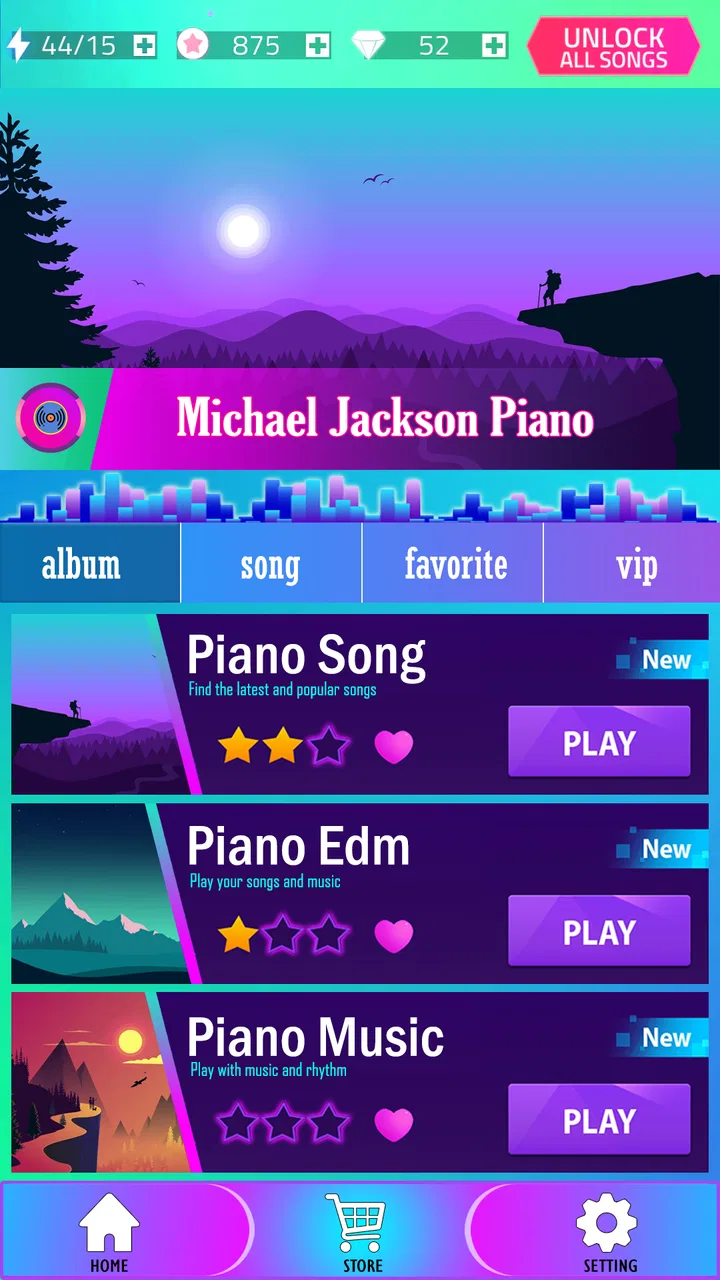
Michael Jackson - Piano Game
- 4.1
- Rating
- 100.00K
- Installs
- Free
- Price

 Analysis by App-foxy
I approached Michael Jackson - Piano Game as a quick music game rather than a full piano-learning tool, and that distinction matters from the first tap. Its appeal is straightforward: familiar Michael Jackson material, a visual piano-style interface, and short sessions that are easy to start when I have a few spare minutes. It is free, rated for Everyone, and developed by Slow_Play-game, so it is clearly aimed at casual players rather than musicians looking for a structured course.
The game has reached over 100 thousand installs and holds a 4.1 average from around 981 ratings, which suggests that its simple idea works for a meaningful group of players. I would not choose it as a replacement for a keyboard, a music-theory app, or a serious rhythm-training program. I would recommend it to someone who wants a lightweight way to interact with songs connected to Michael Jackson and prefers immediate play over lessons, setup, or long explanations.
How I Decided Whether It Was Worth Playing
My first decision criterion was the kind of experience I wanted. If I wanted to learn hand positions, read notation, understand chords, or build a practice routine, this would not be my first choice. The store category is Music, but that does not automatically make it an educational piano application. I treated it as a music-themed game, and that made its strengths and limitations much clearer.
You May Also Like

 Pandora - Music & Podcasts
Pandora’s Music Is Easy to Start, but Harder to Recover
Pandora’s strength is its low-effort path from a seed to a station. Its weak spot is how much confidence it asks you to place in connection, setup, and quiet recovery.

 8 Ball Pool
 Is Built on Rivalries, Rematches, and Routine
A close look at the rivalries, rematches, shared routines, and unanswered safety questions that turn a quick pool match into a persistent mobile community.

 Samsung Music
’s Quiet Strength Is Playing What You Already Own
Its reach comes less from spectacle than from dependable access to a personal library. That simplicity is both the app’s strongest retention engine and its ceiling.

 AccuWeather: Weather Radar
AccuWeather Review: A Quick, Clear Forecast for Everyday Decisions
For everyday plans, the best forecast is the one you can understand quickly. AccuWeather makes rain timing, radar, and local conditions easy to act on, with a few trade-offs.

 Hill Climb Racing
Why Hill Climb Racing Still Turns Crashes Into One More Run
A tiny car, a bumpy hill and one more upgrade: Hill Climb Racing keeps resurfacing because its simple chaos makes every near-miss feel personal.

 AliExpress - Shopping App
AliExpress Makes Global Shopping Feel Personal, but Shoppers Bear the Risk
AliExpress turns a global marketplace into a pocket-sized discovery engine. Its reach is useful, its shopping loop compelling, and its trade-offs easy to miss.
More From Our News Desk
View All News


The second criterion was convenience. A casual game should make sense quickly, especially when played on a phone. The Michael Jackson theme gives the app a recognizable identity, while the piano presentation keeps the interaction familiar even for someone who has never played an instrument. I could imagine opening it during a short break, playing a few rounds, and closing it without needing to prepare a session.
I also considered whether the presentation supports the music or merely decorates it. The store summary points to recent songs and an attractive display, while the short description focuses on Michael Jackson. In practice, that combination sets an expectation of visual rhythm and recognizable musical material, not a complete catalog of piano arrangements. Anyone choosing it should be comfortable with a focused theme instead of expecting a broad music library.
Another useful test is how well the game fits a particular player. A fan of Michael Jackson may enjoy the connection immediately, even if the gameplay remains simple. A child or family member can approach it without needing specialist knowledge, since the age rating is Everyone. On the other hand, a player who mainly wants chart variety, competitive depth, or detailed progress tracking may quickly find the concept narrow.
I would also separate “playing music” from “making music.” A piano game can feel musical without allowing the player to freely compose or perform any song. That difference affects expectations. I found the strongest reason to use this title in the moment-to-moment interaction, not in the promise of becoming a better pianist.
What the Michael Jackson focus adds
The theme is more than a label because it gives the game a clear mood. Many casual music games rely on a rotating mixture of songs and visual effects, which can make them feel interchangeable. This one has a specific artist at its center. If that artist is already part of your listening habits, the game has an emotional shortcut: you know why you are opening it before you even begin.
That focus can also make the app a better choice for a shared device. I can see a parent handing it to a child who recognizes the name, or friends taking turns with a song-themed challenge without needing to explain a complicated fictional world. The experience is easier to introduce when the musical identity is already familiar.
The trade-off is obvious but important. A strong theme can become restrictive. If I am in the mood for different genres, current chart music, or a broad selection of artists, the app is less appealing than a general rhythm game. The focused catalog is part of its personality, but it also defines its ceiling.
Where it feels most useful in everyday play
My favorite use case is a short, low-pressure break. Imagine waiting for a friend, sitting on public transport, or taking a few minutes away from work. I would not need headphones, an instrument, or a planned lesson. I could open the game, concentrate on the screen, and stop when the break ends. That makes it more practical than an app that demands a longer commitment.
There is also a useful “first music game” role here. Someone who is curious about piano games but does not want to study notation can start with a more approachable interface. The player can focus on timing and visual attention without first learning technical vocabulary. That does not turn the app into a lesson, but it can make the category less intimidating.
A less obvious use is as a test of whether a player actually enjoys rhythm-based interaction. Before spending time with more elaborate music games, I could use this kind of simple title to discover whether tapping along with a visual track feels satisfying. If it does, moving to a deeper alternative becomes an informed choice rather than a guess.
Where the game wins against broader alternatives
The biggest advantage is focus. A general music game may offer more variety, but it can also feel anonymous. Here, the Michael Jackson identity gives the experience a reason to exist. I would choose this over a generic piano game when the artist matters more to me than having the widest possible selection.
It also wins on accessibility. There is no need to understand music theory to appreciate the premise, and the Everyone rating makes it suitable for a broad audience. That is useful when the goal is casual entertainment rather than skill certification. A more advanced application may teach more, but it may also ask for patience that a quick phone game does not require.
The free price is another practical advantage. I can try it without committing money, which lowers the risk for someone who is unsure about the theme or the gameplay style. Free does not guarantee that every player will enjoy it, but it makes the decision easier: install it, spend a little time with it, and keep it only if the interaction feels worthwhile.
The current version is 6.0, and the app runs on Android 6.0 or later. That broad compatibility is helpful for people using an older Android phone, although smoothness will still depend on the device. I would keep expectations realistic when playing on aging hardware: a simple game may be convenient, but an older phone can still affect touch response, loading, or visual comfort.
Small habits that make short sessions better
I found that the best way to approach a game like this is to play in deliberate bursts instead of leaving it open as background entertainment. Put the phone at a comfortable angle, reduce distractions, and treat one short session as a focused rhythm exercise. That makes the visual timing easier to follow and prevents the game from becoming repetitive too quickly.
A second useful habit is to decide what I want from each session. Sometimes I want to relax with familiar music; other times I want to test my attention. Those are different goals. If I expect a learning system while actually seeking a few minutes of entertainment, I will judge the app unfairly. Setting the right expectation improves the experience more than repeatedly changing settings or searching for hidden depth.
I would also avoid presenting it to a child as a piano lesson. The musical theme may encourage curiosity, but a game interface is not the same as guided instruction. For a young player, it works better as a playful introduction to rhythm and a familiar artist. If the child wants to learn real piano technique afterward, a teacher or dedicated learning application would be the more suitable next step.
When Another Type of App Fits Better
The most important alternative is a genuine piano-learning application. Those tools are better when the goal is posture, note recognition, scales, chords, or a progressive curriculum. They usually demand more time and attention, but that extra structure is exactly what a learner needs. I would switch away from this game if I wanted measurable musical development rather than a casual tapping experience.
A general rhythm game may be a better choice for players who value variety. If I want multiple genres, different artists, or a constantly changing playlist, a broader title will probably hold my interest longer. The decision comes down to whether the Michael Jackson theme is the main attraction or merely one preference among many.
A virtual instrument app is another category to consider. It can offer more freedom to tap keys, experiment with melodies, or play without following a game pattern. That freedom is useful for someone who wants to create or improvise. The trade-off is that a virtual instrument may feel less immediately entertaining because it does not necessarily provide the same game-like direction.
Music streaming is also a realistic alternative, especially for listeners who primarily want to hear the songs. Streaming gives me a more direct listening experience, while this game asks me to interact with the screen. If I am commuting and want uninterrupted music, a streaming app is the clearer choice. If I want a small activity connected to the music, this game has the advantage.
These alternatives do not make the game poor; they simply serve different intentions. I would not compare a casual piano game with a lesson app by asking which one teaches more. I would ask which one removes the most friction from the activity I actually want to do.
Limitations I noticed before recommending it
The narrow artist focus is the first limitation. It is a strength for fans, but it can reduce replay appeal for everyone else. Even a well-presented game can feel repetitive when its musical identity is too specific for the player’s taste. I would try it because it is free, but I would not assume that the Michael Jackson connection alone guarantees long-term interest.
The second limitation is the gap between piano imagery and piano skill. A player may enjoy the visual idea while learning very little about actual keyboard performance. That is not a flaw if the purpose is entertainment, but it becomes a problem when the app is chosen with educational expectations.
The third limitation is the lack of a broader decision-making context inside the experience. A casual game can be enjoyable without deep systems, yet players who want detailed goals, layered progression, or a strong sense of mastery may prefer a more specialized title. I would skip this one if I already know that simple sessions stop holding my attention quickly.
There is also a practical issue with phone play: touchscreens are not keyboards. Even when the display looks attractive, the surface offers no physical key feedback. That can make timing feel less natural for someone accustomed to an instrument. I would judge the game by its responsiveness as a phone game, not by whether it reproduces the feel of a real piano.
What switching to another option would cost
Moving to a piano-learning app usually costs time and concentration, even when the application itself is free. I would need to follow lessons, repeat exercises, and accept a slower start. The reward is greater structure, but the immediate fun may be lower. Switching makes sense when long-term skill matters more than effortless entertainment.
Moving to a broad rhythm game costs some of the identity that makes this title memorable. I might gain variety but lose the specific connection to Michael Jackson. For a fan, that emotional difference can matter more than a larger song selection. For a casual player without a strong preference, variety will probably be the better bargain.
Moving to streaming costs interactivity. I would no longer have a game to occupy my hands, but I would gain a more direct way to listen. This is why I would not treat the two as substitutes in every situation. One is an activity built around music; the other is primarily a listening tool.
Because this title is free, the cost of trying it is relatively low. The real cost is attention: a few sessions are enough to decide whether the theme and interface suit me. I would uninstall it if I kept opening it out of habit without enjoying the interaction, rather than keeping it simply because it takes little commitment.
Who should install it
I would recommend it to Michael Jackson fans who want a casual music game, families looking for an approachable phone activity, and players curious about piano-style rhythm games. It is especially suitable for short sessions, quick experimentation, and people who prefer a recognizable theme over a huge range of unrelated content.
I would be more cautious with musicians, students, and players seeking serious practice. The game may support interest in music, but it should not be mistaken for a substitute for an instrument or a structured course. I would also point genre-focused players toward a broader rhythm game if they are unlikely to enjoy repeating one artist’s musical world.
The rating of Everyone makes it an easy title to consider for a wide age range, but adults should still explain the difference between tapping a game and learning piano. That small clarification prevents disappointment and helps younger players enjoy the app for what it is.
My recommendation after weighing the trade-offs
My final view is positive but specific: this is a good free pick for casual Michael Jackson-themed music play, not a complete piano experience. I like its clear identity, approachable premise, and low barrier to trying it. The 4.1 average from nearly a thousand ratings also indicates that the straightforward format has found an audience.
I would install Michael Jackson - Piano Game when I wanted a short, artist-focused game and had no need for lessons or a large music catalog. I would keep a broader rhythm game nearby for variety and choose a learning app whenever improvement at a real keyboard became the priority.
That is the fairest way to decide: begin with the artist, the session length, and the kind of interaction you want. If those three choices point toward a simple piano-style game, the free download makes experimentation easy. If they point toward education, composition, or endless variety, another category will serve you better from the start.
FAQs for Michael Jackson - Piano Game
01What is Michael Jackson - Piano Game?
Michael Jackson - Piano Game is a rhythm-based music game where players tap on tiles in sync with Michael Jackson's iconic songs. The game challenges players to keep up with the beat while enjoying a vast selection of the King of Pop’s greatest hits, offering both entertainment and a test of reflexes.
02Is Michael Jackson - Piano Game free to play?
Yes, Michael Jackson - Piano Game is free to download and play. However, it may include in-app purchases or advertisements. Players can choose to buy additional features or remove ads, enhancing their gaming experience without mandatory spending.
03Which devices are compatible with Michael Jackson - Piano Game?
The game is available for both Android and iOS devices. It requires a minimum of Android 4.4 or iOS 9.0 to run smoothly. Users should ensure their device meets these specifications to avoid performance issues during gameplay.
04Does the game feature original Michael Jackson songs?
Yes, the game features original tracks from Michael Jackson's discography. Players can enjoy classics like "Billie Jean" and "Thriller" while playing. The game aims to replicate the excitement of his music and allows players to tap along to the rhythm of his famous beats.
05Are there multiplayer features in Michael Jackson - Piano Game?
Currently, the game focuses on single-player experiences, allowing users to compete against their own high scores. However, some updates may introduce leaderboards or social media integration for players to share scores and challenge friends.
Pros
- Engaging gameplay with iconic MJ hits.
- Simple controls for all skill levels.
- Regular updates with new songs.
- Visually appealing graphics.
- Offline mode available.
Cons
- Limited song selection initially.
- Ads can be intrusive at times.
- Requires internet for updates.
- In-app purchases for premium songs.
- May drain battery quickly.

Michael Jackson - Piano Game
Gallery